1. Say what you'll do
You write the commitment specifically enough that nobody could argue about it. Not "exercise more." Run 5k, Monday, Wednesday and Friday, before 7am. Commitments run daily, on specific weekdays, or a set number of times per week, with an optional deadline time and completion window. Everything is timezone-aware, so your day ends when your day ends.
The specificity is the point. Vague terms always resolve in favour of the version of you looking for a way out, and "I'll do it tomorrow" is the most practiced sentence in the language. A commitment precise enough to check is one you can't quietly reinterpret.
2. Decide how you'll prove it
This is the part that makes the rest work. A streak you award yourself is a wish with a number next to it. The moment the streak matters, marking today complete becomes irresistible, and you know it, which is why the number stops meaning anything to you too.
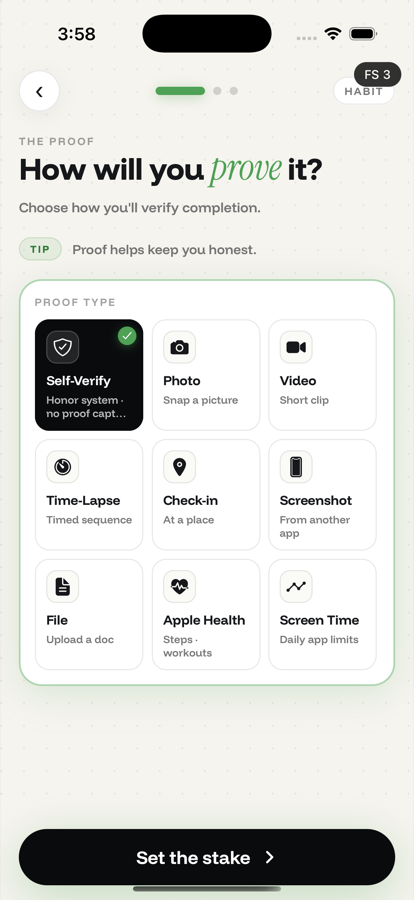
So you pick the evidence up front, before there's anything to be defensive about: a photo, a short video, a live time-lapse, a GPS check-in at a specific place, a screenshot, a document, Apple Health data, or an iOS Screen Time reading. Before-and-after photo pairs work too, for the things where the middle is the point.
Pick the proof that closes your particular loophole. If you know how you'd cheat, you know which one to choose. And yes, Self-Verify, honor system is right there as the first option, because some commitments genuinely don't need a receipt.
3. Decide who checks
Commit works solo, and it works with people. Solo, your proof is reviewed by Commit AI: a scored review, not a rubber stamp, that escalates the cases it isn't sure about rather than guessing. With people, the friends you name are the ones who approve or reject your proof.
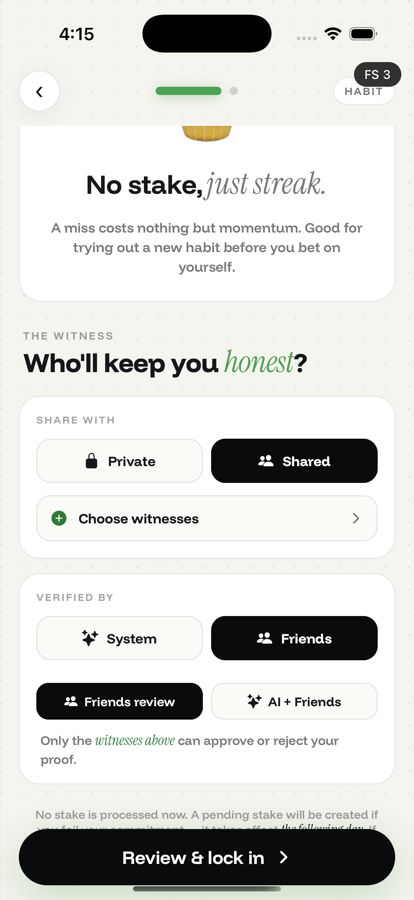
Sharing goes further than verification. You can bring friends into a group of up to ten, invite them by QR code, share commitments, challenge each other, and react to each other's proof. A shared commitment builds a group streak: it counts every consecutive day that everyone showed up. Quitting in private is easy. Quitting in front of people who watched you sign up for it is a different experience.
If you want the fuller argument about why buddy systems usually fail and what fixes them, that's here.
4. Decide what a miss costs
A consequence is anything that makes skipping cost more than showing up. You choose it now, while you mean it. In order of weight:
- The streak. "No stake · just streak": a miss costs momentum and nothing else. On a shared commitment it costs more, because your miss ends the group streak for everyone. This is the honest starting point for a habit you're still testing.
- Your apps. A miss blocks the apps you chose, through iOS Screen Time. The thing you'd have reached for instead is the thing you lose.
- Earn it back. Screen time comes back for pushups, jumping jacks or squats. Slightly absurd, and it works.
- Money, if you want real weight. $1 to $500. Nothing is charged when you commit. If you miss, a hold is placed, and you have 72 hours to appeal before it's collected. Stakes are service fees to Cognitive Health Research LLC, Commit's parent company; in the beta, funds go to building the app. Not available in every country.
Pick the smallest one that would actually change your Tuesday. Over-staking makes people avoid setting goals at all, which is worse than no system.
5. Sign it
Then you sign, with your finger, in your own handwriting. This is the part people expect to feel like a formality and report doesn't.
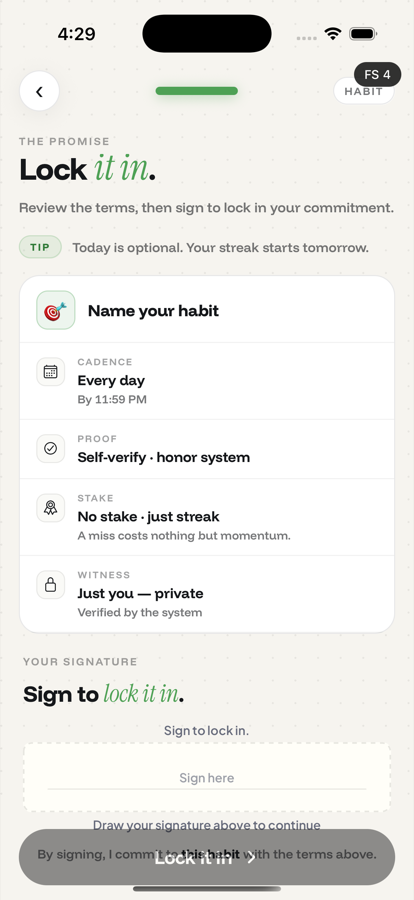
Everything you decided is on one card: what, when, how you'll prove it, what a miss costs, who's watching. You read it once as the person who's thinking clearly, and you sign. The terms are set while you mean them, and they don't reopen when you don't. Tomorrow-you doesn't get to renegotiate at 6am, because there's nothing left to negotiate.
Note what the card above says under STAKE: No stake · just streak. A miss costs nothing but momentum. That's a complete, working commitment with no money in it.
What happens the next morning
You do the thing, you submit the proof, and someone who isn't you rules on it. The proof goes to the friends you named, or to Commit AI, and comes back approved or rejected. There's no box you can quietly tick. That's the whole trade: a little friction at the moment of proof, in exchange for a record you can actually believe.
If a proof is rejected and you think that's wrong, appeal it. Appeals are judged at a deliberately lower bar than the original review, and a successful appeal restores your streak and cancels any charge. Proofs also work offline: they queue on your phone and upload the moment you're back.
This mechanism is why Commit fits the person who says "I know exactly what I have to do, I'm just not doing it." It's also why it fits ADHD and chronic procrastination: the decision doesn't have to be re-made at the moment of weakness, because it was already made, in writing, by the version of you who meant it. The negotiation is removed, not won. More on why consistency is a structure problem rather than a character problem in how to stay consistent when motivation fades.
When you have a genuinely bad day
The system is built to know the difference between an excuse and a life. You can reschedule within 24 hours, submit proof late for review, deliberately skip a day, or pause a habit over a date range.
And you start with 10 grace tokens, earning another at each streak milestone: 7, 14, 21, 30, 60, 90, 100, 180 and 365 days. Spend one within 48 hours of a miss and the day is marked skipped, your streak survives, and any stake is reversed. They're finite on purpose. Unlimited forgiveness is the same thing as having no rule.
One missed day is a missed day, not a verdict. If missing once tends to become quitting entirely for you, this piece is about exactly that pattern.
What it doesn't do
Worth knowing before you decide it's for you:
- No group chat, no DMs. Reactions on someone's proof are hearts, not comment threads, and the in-app chat reaches our support team only.
- iPhone only. No iPad, no web app, no Android yet. Android is planned.
- It's in public beta through TestFlight and isn't on the App Store yet, so there's no download link we could give you today that would work. It's free while in beta.
- In development, not shipped: a stake that posts to your social media if you miss, and run-length challenges like a 30-day video challenge.
Commit is in public beta
iPhone, free while in beta. We'll email you when a spot opens.
Join the betaWant the reasoning first? What a commitment device is covers the behavioural economics, including where the evidence is weaker than people claim. The Commitment Agreement is the actual contract you'd sign.